Across Greater Boston, commercial real estate developers, property asset managers, and mechanical engineering firms are confronting the strictest decarbonization building codes in the United States. Between Boston’s BERDO 2.0, Cambridge’s Net Zero Action Plan (NZAP), and Massachusetts’ Specialized Opt-In Stretch Code, continuing to burn fossil gas or oil is no longer just environmentally obsolete—it is an escalating financial liability.
At Geothermal Drilling of New England, we serve as the specialized exterior drilling subcontractor helping mechanical contractors, architects, and general contractors execute engineer-certified borefields that permanently resolve compliance requirements.
The Carbon Penalty Horizon: Boston BERDO 2.0
Under the City of Boston's Building Emissions Reduction and Disclosure Ordinance (BERDO 2.0), commercial and residential buildings 20,000 square feet or larger face mandatory emissions thresholds that step down aggressively toward net-zero by 2050:
- Mandatory Emissions Caps: Properties exceeding emissions intensity limits face alternative compliance payments set at $234 per metric ton of CO2e.
- Penalties for Inaction: A 100,000 sq ft commercial office or laboratory relying on gas boilers or dual-fuel systems risks tens of thousands of dollars in recurring annual municipal fines starting in 2025–2030.
- Grid Winter Peak Constraints: Standard air-source heat pumps struggle during sub-zero cold snaps, pulling excessive grid power and triggering severe electrical service upgrades.
Why Geothermal Wins Commercial Decarbonization
Ground-source heat pumps operate with a winter heating COP of 4.2 to 5.0+, pulling baseline energy from 50°F bedrock rather than freezing ambient air. This cuts electrical peak demand by 40% to 50% compared to air-source heat pumps, allowing commercial properties to electrify within existing electrical transformer and utility service capacities.
Urban Density Solutions: Standing Column Wells for Zero-Lot-Line Parcels
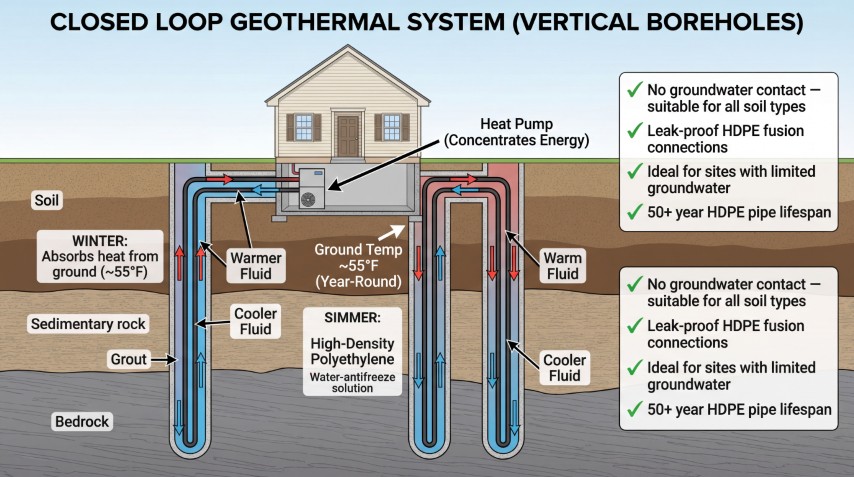
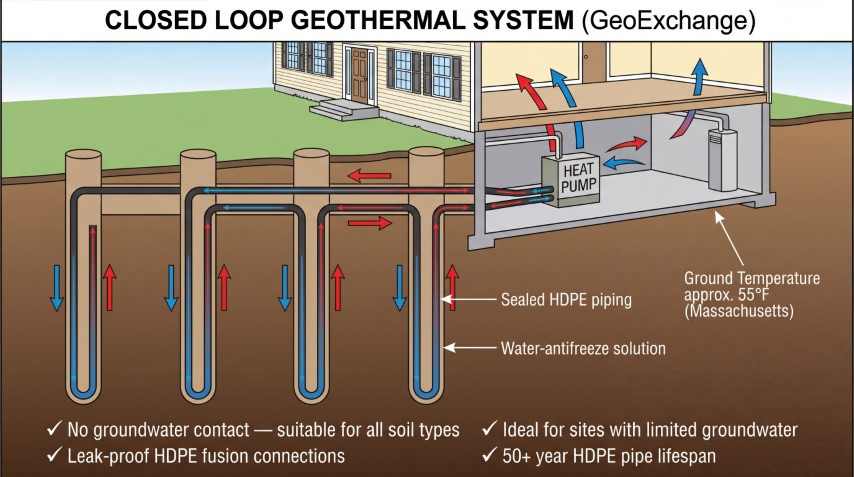
In urban corridors like the Seaport, Back Bay, Kendall Square, and Harvard Square, the primary hurdle to geothermal is surface real estate. Standard closed-loop borefields requiring 20-foot spacing cannot fit on tight commercial footprints.
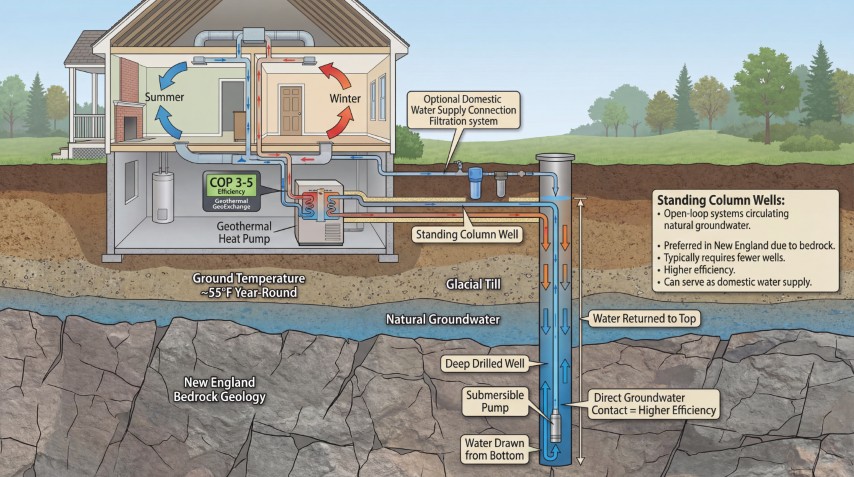
As demonstrated in our Harvard University campus project, GDNE specializes in deep Standing Column Wells (SCW) drilled 1,000 to 1,500 feet into bedrock. A single SCW delivers 30 to 35 tons of thermal exchange on a surface footprint under 150 square feet. By grouping 3 to 6 SCWs under parking garages or basement foundations, commercial multi-story facilities can achieve 100% net-zero heating and cooling.
Federal Section 48 ITC & Tax Incentives for Commercial Developers
While residential clean energy tax credits faced changes under recent federal legislation, the Commercial Section 48 Investment Tax Credit (ITC) remains one of the most powerful capital incentives in the tax code:
- Base 30% Investment Tax Credit: Commercial geothermal installations qualify for a 30% federal tax credit when prevailing wage and registered apprenticeship standards are met.
- +10% Domestic Content Bonus: Projects utilizing domestically manufactured HDPE pipe, casing, and heat pump equipment qualify for an additional 10% tax credit.
- +10% Energy Community Bonus: Projects situated in designated brownfields or energy communities qualify for an additional 10% adder, bringing total federal tax credits up to 50% of total project cost.
- Modified Accelerated Cost Recovery System (MACRS): Geothermal equipment qualifies for 5-year accelerated depreciation, providing immediate cash-flow relief for commercial asset holders.
Subcontracting with GDNE: How We Partner with MEPs & GCs
GDNE operates exclusively on the exterior thermal infrastructure, allowing mechanical prime contractors and consulting engineers to focus on indoor distribution:
- Pre-Bid Thermal Feasibility & Test Borings: We perform 48-hour pilot TRT testing and lithological rock logging to provide PE-certified conductivity data for GLD borefield sizing.
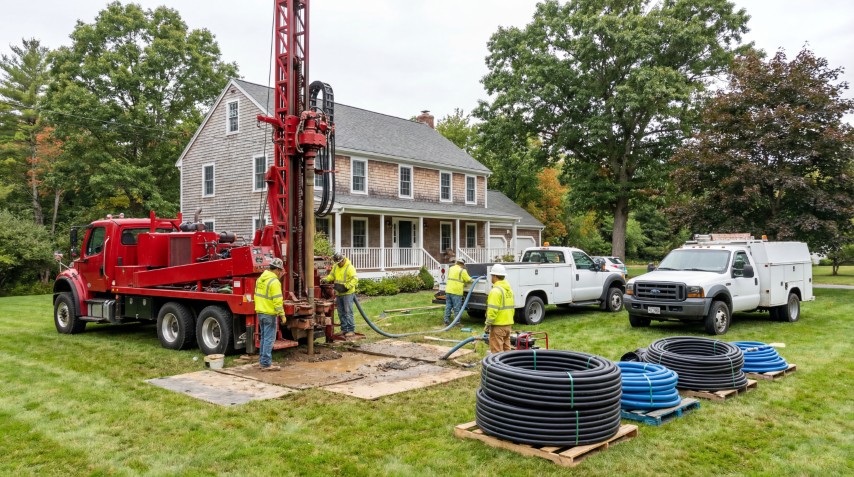
- Turnkey Drilling & Loop Installation: Our fleet of rotary rigs, sound-attenuated compressors, and slurry containment systems drill and loop boreholes with zero jobsite disruption.
- Certified Electrofusion & Header Vaults: Our PPI-certified fusion technicians install pre-cast manifold vaults, balancing valves, and building-penetration stub-outs ready for mechanical HVAC tie-in.
To submit an RFP or schedule an engineering plan set review, visit our Commercial Subcontractor Hub or call our direct estimating desk at 1-800-339-9051.