Decarbonizing historic institutional campuses presents a classic architectural dilemma: how do you deliver hundreds of tons of high-efficiency heating and cooling on dense urban parcels where surface area is virtually non-existent, historic preservation guidelines prohibit visible rooftop equipment, and street-level noise must remain below municipal decibel caps?
At Harvard University in Cambridge, Massachusetts, Geothermal Drilling of New England (GDNE) partnered with campus facility planners and MEP consulting engineers to execute a multi-phase geothermal borehole program. The solution was the deployment of deep Standing Column Wells (SCW) drilled directly into the Boston Basin's sedimentary Cambridge Argillite bedrock.
The Engineering Challenge: Zero Surface Tolerance
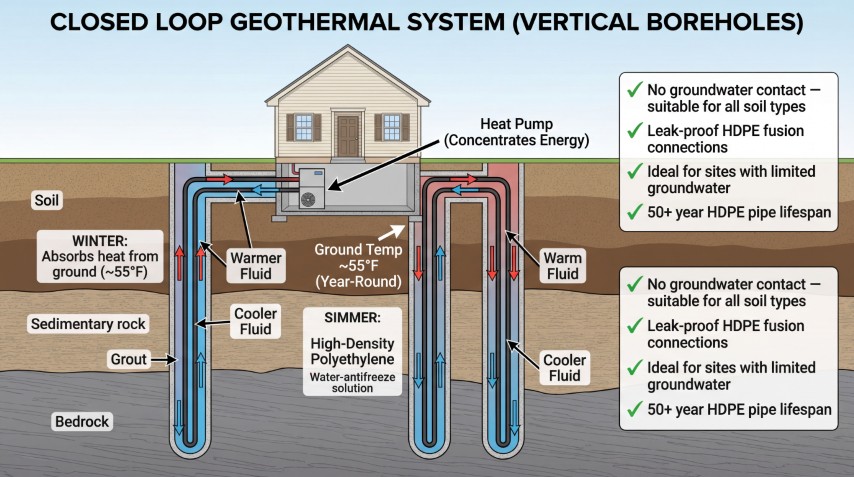
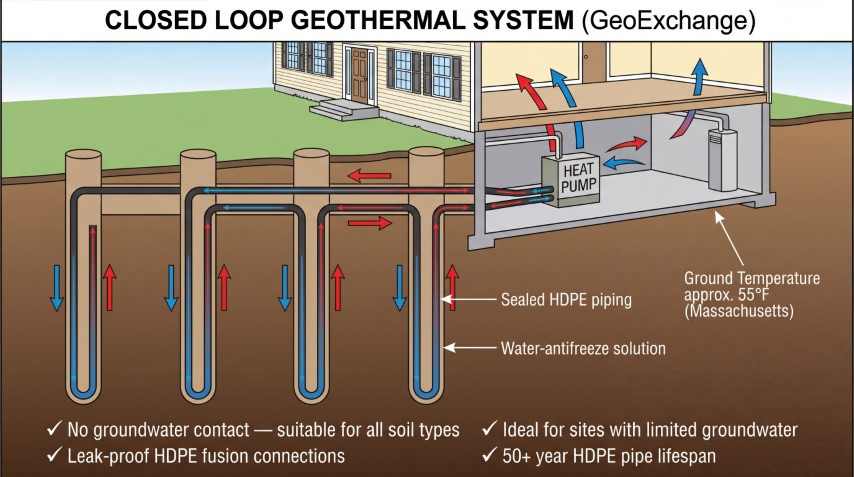
Conventional vertical closed-loop borefields typically require 150 to 200 linear feet of borehole per ton of thermal capacity, spaced on a 15- to 20-foot grid. On a multi-building university campus bordered by historic brick structures and active city thoroughfares, dedicating thousands of square feet of surface real estate to a horizontal loop header grid was physically impossible.
Furthermore, cooling towers were unacceptable due to evaporative water consumption, plume visibility, and aesthetic restrictions within Harvard Square historic view corridors.
Project Snapshot: Harvard Campus SCW Program
- Location: Cambridge, MA (Middlesex County)
- Borehole Depths: 1,000 to 1,200 feet into bedrock
- Geological Formation: Cambridge Argillite (Boston Basin)
- Thermal Yield: ~30 to 35 tons per borehole
- Surface Real Estate Footprint: Less than 150 sq ft per wellhead vault
- Compliance Mandates: Cambridge Net Zero Action Plan (NZAP) & MassDEP UIC Guidelines
Standing Column Well Mechanics in Cambridge Argillite
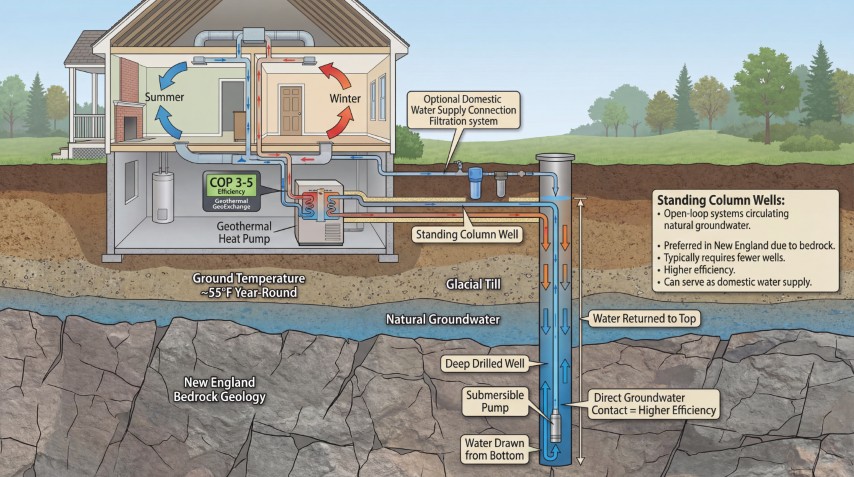
Unlike closed-loop systems that exchange heat through plastic pipe walls and grout, a Standing Column Well operates via direct groundwater thermal transfer. Groundwater is drawn from the deep bedrock formation, pumped through high-efficiency indoor water-to-water heat pump exchangers, and returned to the top of the identical well column.
Because Cambridge Argillite possesses consistent thermal inertia and moderate groundwater yield, the system leverages high-rate convective heat transfer. During peak thermal events, an automated "bleed control" cycle discharges 5% to 10% of the circulating water to storm drainage, inducing fresh 50°F groundwater recharge from the surrounding bedrock fracture network. This prevents seasonal thermal buildup and sustains exceptional system efficiency:
| Metric | Conventional Closed-Loop | Harvard Standing Column Well |
|---|---|---|
| Surface Footprint (100 Tons) | 15,000 – 25,000 sq ft | < 600 sq ft (3–4 SCWs) |
| Borehole Count | 20–25 boreholes (500 ft) | 3–4 boreholes (1,000–1,200 ft) |
| Thermal Transfer Medium | Conduction through HDPE & Grout | Direct Bedrock Water Contact (Convection) |
| Cooling Tower Requirement | Frequently required for peak shedding | Zero (100% ground heat rejection) |
| Seasonal Heating COP | 3.8 – 4.2 | 4.5 – 5.2+ |
Urban Drilling Protocols & Vibration Telemetry
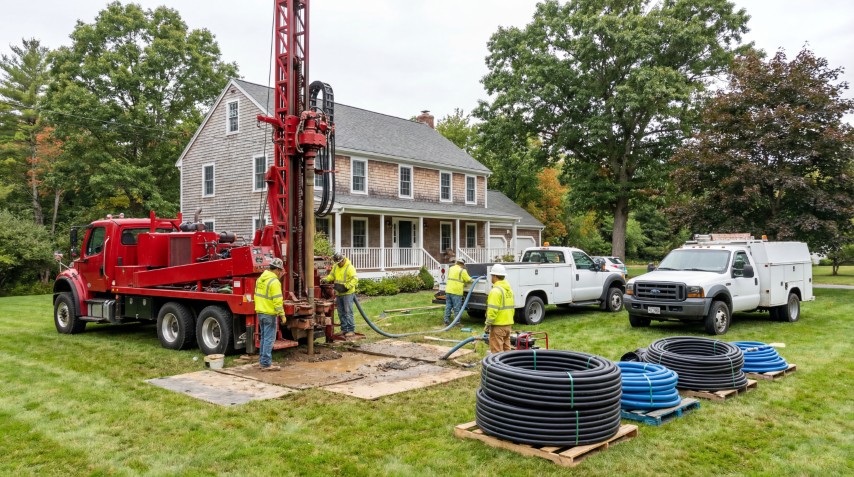
Drilling 1,200-foot boreholes adjacent to 19th-century masonry requires specialized site controls. GDNE implemented strict operational safety measures:
- Sound-Attenuated Rig Enclosures: Custom acoustic compressor shrouds and muffled exhaust stacks reduced drilling sound levels below the Cambridge DPW 65 dBA property-line threshold.
- Seismic Vibration Monitoring: Tri-axial seismographs installed at adjacent foundation footings recorded continuous peak particle velocity (PPV), ensuring drilling harmonic energy remained far below structural safety limits.
- Closed Slurry Containment: Cuttings separation tanks and decanting centrifuges contained all drill cuttings and groundwater return, keeping Cambridge municipal roadways completely clean and sediment-free.
Long-Term Institutional Impact
The completed standing column wells have operated continuously with zero exterior equipment visibility, zero cooling tower water consumption, and zero localized combustion emissions. The installation serves as an engineering benchmark for university campuses, hospitals, and commercial real estate developers throughout Greater Boston seeking compliance with Boston BERDO 2.0 and Cambridge NZAP decarbonization laws.
For detailed engineering consultations regarding urban standing column feasibility, contact the GDNE commercial engineering desk.