In commercial geothermal engineering, borehole footage is the single largest line item in the capital expenditure budget. Drilling 1,000 feet deeper than necessary can add $40,000 to $60,000 in needless subcontracting costs. Drilling 1,000 feet too short risks long-term thermal runaway and equipment failure.
Yet across Massachusetts, New Hampshire, and Connecticut, mechanical engineers frequently design 50- to 200-ton commercial borefields using conservative "handbook book values" for rock conductivity. At GDNE, our mobile 48-hour in-situ Thermal Response Testing (TRT) program proves that New England's dense igneous and metamorphic geology frequently outperforms handbook estimates by 25% or more.
Empirical Conductivity Across New England Formations
Thermal conductivity ($k$) is measured in $\text{BTU}/(\text{hr}\cdot\text{ft}\cdot{^\circ}\text{F})$. Higher conductivity allows heat to diffuse through bedrock rapidly, reducing the linear feet of drilling required per ton of building load:
| Geological Formation / Region | Dominant Rock Type | Empirical Conductivity ($k$) | Drilling Impact |
|---|---|---|---|
| White Mountain Plutonic Series (NH) | Quartz Syenite & Granite | 1.9 – 2.4 BTU/hr-ft-°F | Superior heat dissipation; lowest footage/ton required. |
| Dedham Granodiorite (Eastern MA) | Proterozoic Granite / Diorite | 1.6 – 1.9 BTU/hr-ft-°F | High quartz content yields outstanding closed-loop stability. |
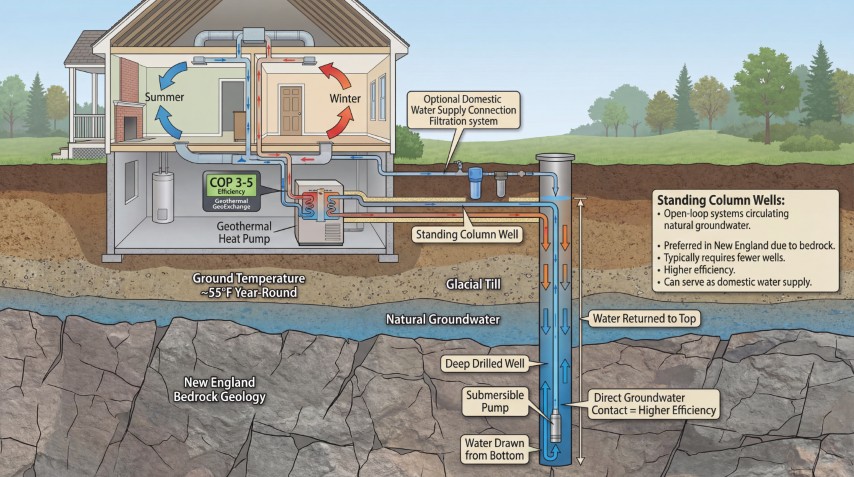
| Boston Basin (Cambridge/Boston) | Cambridge Argillite / Siltstone | 1.4 – 1.7 BTU/hr-ft-°F | Ideal for Standing Column Wells with fracture bleed cycles. |
| Nashoba Terrane (Middlesex/Worcester) | Gneiss & Biotite Schist | 1.5 – 1.8 BTU/hr-ft-°F | Competent rock; excellent grout-to-bedrock thermal bonding. |
| Hartford Rift Basin (CT / Western MA) | New Haven Arkose / Portland Sandstone | 1.1 – 1.4 BTU/hr-ft-°F | Requires 15–20% more linear footage due to sedimentary porous matrix. |
How a 48-Hour In-Situ TRT Test Works
Adhering to ASHRAE 1118-TRP and IGSHPA standards, GDNE executes in-situ testing using mobile automated test trailers:
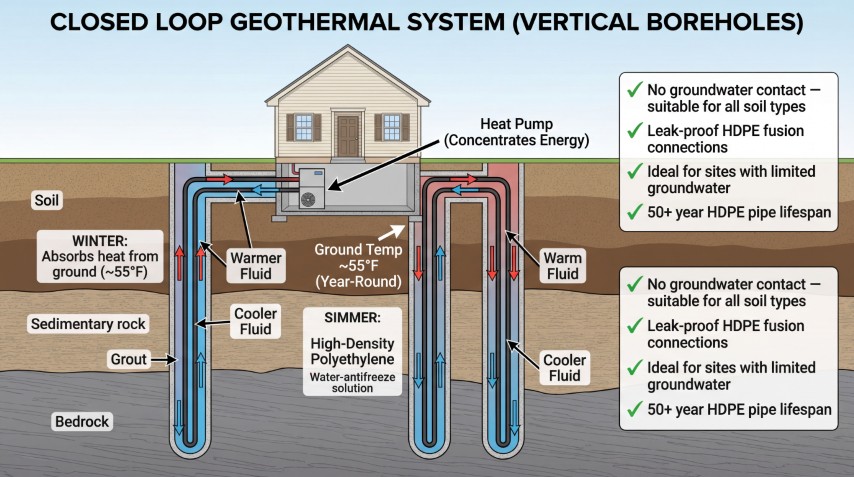
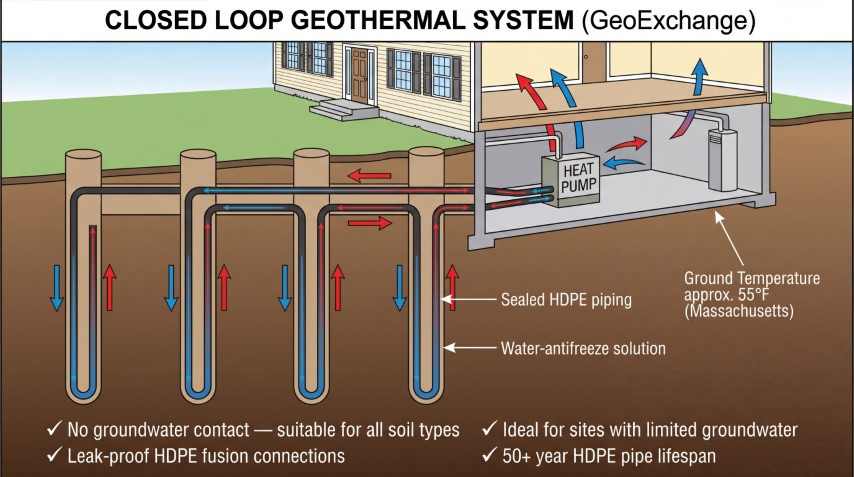
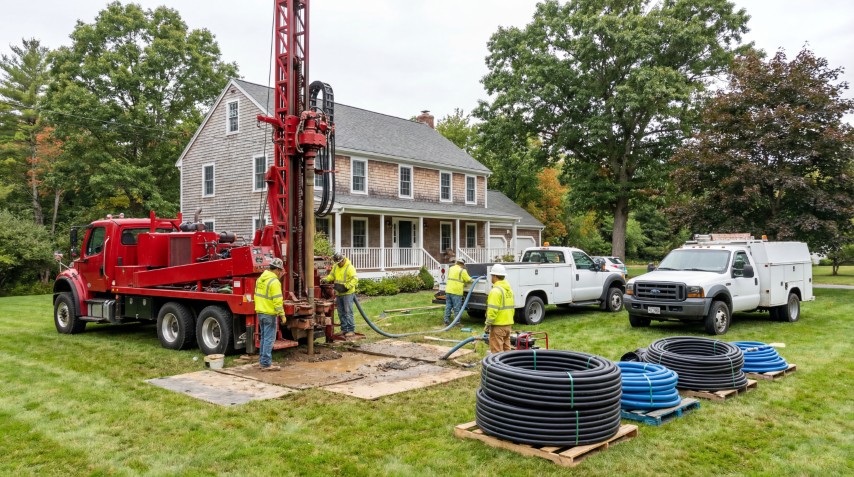
- Pilot Borehole Installation: A test borehole is drilled, equipped with the exact specified HDPE U-tube loop, and pressure-grouted with the engineered thermal grout.
- Thermal Stabilization: The borehole rests for 5 to 7 days until drill bit frictional heat dissipates and the well equilibrates to undisturbed ground temperature ($T_g$).
- Continuous Constant Heat Injection: For 48 to 72 continuous hours, electric heating elements inject a constant thermal load (typically 15 to 25 W/ft) into circulating water.
- Line Source Theory Analysis: High-precision thermistors log entering and leaving water temperatures every 10 seconds. Using Kelvin's Line Source Theory, the temperature response curve is evaluated to extract certified formation thermal conductivity ($k$) and borehole thermal resistance ($R_b$).
Real-World Capital Savings Example
On a 100-ton commercial office complex in Lexington, MA, the initial handbook estimate assumed a conservative $k = 1.25\text{ BTU/hr-ft-}^\circ\text{F}$, requiring 24 boreholes at 500 ft (12,000 total linear feet).
GDNE drilled a test borehole and completed a 48-hour TRT, proving the actual Dedham granite achieved $k = 1.78\text{ BTU/hr-ft-}^\circ\text{F}$. The mechanical engineer revised the wellfield design to 18 boreholes at 500 ft (9,000 total linear feet).
Net Result: Eliminating 3,000 linear feet of drilling saved the developer $72,000 in direct construction costs—against an initial testing fee under $12,000.
Pilot Wells Become Production Wells: Zero Wasted Footprint
A common misconception among commercial developers is that test boreholes are discarded expenses. When coordinated by GDNE, the pilot test well is surveyed directly into the engineer's final borefield coordinates. Once testing concludes, the well is flushed, pressurized, sealed, and integrated into the permanent loop manifold.
Explore our comprehensive Formation Thermal Conductivity Test Guide for full mathematical derivations and equipment specifications.