New England winters are notorious for severe sub-zero cold snaps and brutal heating bills. For generations, homeowners from MetroWest Boston to southern New Hampshire have endured unpredictable heating oil truck deliveries, $800 winter monthly fuel bills, and loud, smelly basement burners.
Today, hundreds of property owners across Massachusetts, Connecticut, and New Hampshire are quietly breaking free from deliverable fossil fuels by tapping the infinite thermal battery directly beneath their lawn: bedrock geothermal (GeoExchange).
The Thermodynamic Flaw of Heating Oil & Air-Source Pumps
When you burn #2 heating oil, you are paying for fuel delivery, tank storage liability, and burning a carbon flame that sends 15% to 20% of its energy directly up the chimney flue. An 85% AFUE oil boiler consumes $1.00 of fuel to produce $0.85 of heat.
Air-source heat pumps (mini-splits) are a step forward, but they suffer from a fundamental thermodynamic paradox: when you need heat the most (during a 5°F polar vortex), the outside air has the least heat to give. Air-source units must cycle into power-hungry electric resistance defrost modes, causing winter electric bills to spike.
The Bedrock Constant: 50°F All Winter Long
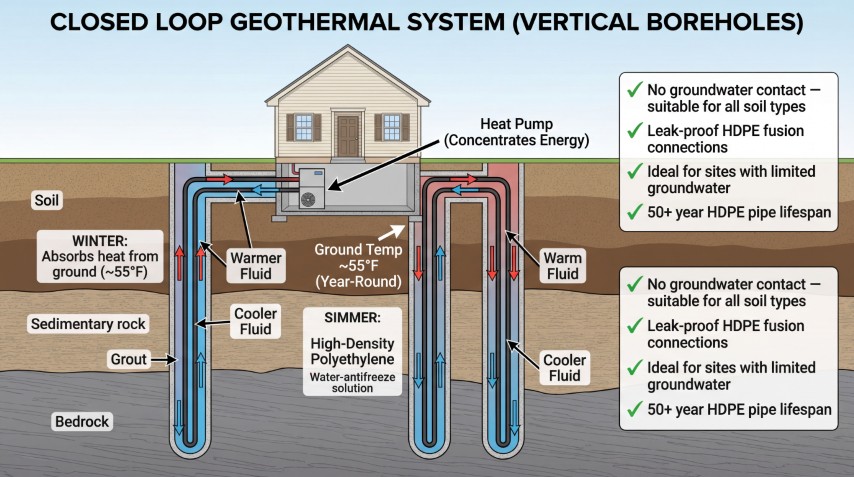
Regardless of whether it is 95°F in July or -10°F in January, the bedrock 100 feet beneath your home in Massachusetts remains at a steady 50°F to 55°F year-round.
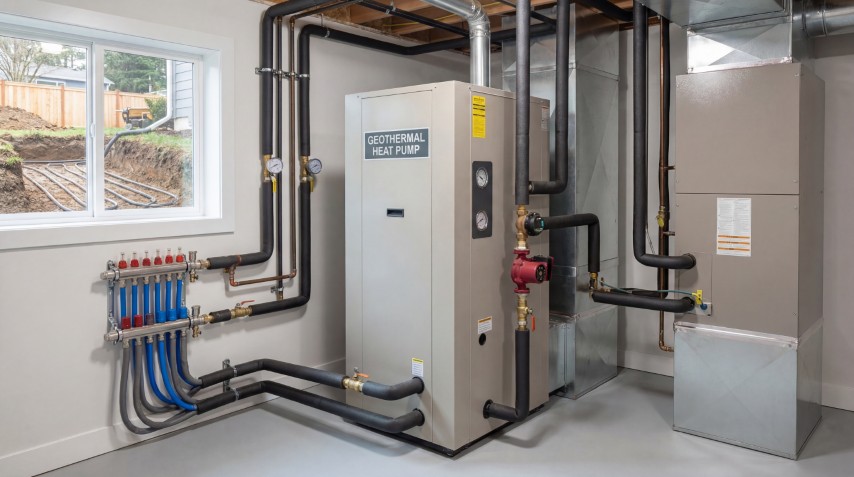
A geothermal heat pump does not create heat through combustion; it simply absorbs existing 50°F solar heat stored in bedrock and concentrates it into your home. For every 1 unit of electricity used to run the compressor, it delivers 4 to 5 units of usable heat into your living space (400% to 500% efficiency).
2026 Financial Incentives: The True Cost to Switch
While geothermal has always provided the lowest operating cost of any heating system, upfront drilling capital was historically a hurdle. In 2026, Massachusetts and New England state programs have lowered the net entry barrier significantly:
- Mass Save Whole-Home Rebates: Massachusetts utility customers can receive $13,500 for whole-home ground-source heat pump conversions, and up to $25,000 for income-eligible households.
- Mass Save 0% Interest HEAT Loan: Finance up to $25,000 at 0% interest for 7 years, allowing your monthly fuel savings to pay for the system installation.
- Alternative Energy Credits (AECs): Massachusetts homeowners earn ongoing quarterly cash payments through the MA Alternative Portfolio Standard (APS), generating an estimated $4,000 to $6,500 in passive cash over a 10-year period.
| Heating System Type | Seasonal Efficiency | Annual Heating Cost (3,000 sq ft) | System Lifespan |
|---|---|---|---|
| #2 Heating Oil Boiler | 80% – 85% AFUE | $3,800 – $4,600 / yr | 15 – 20 Years |
| Propane Furnace | 88% – 92% AFUE | $3,600 – $4,400 / yr | 15 – 20 Years |
| Standard Cold-Climate Air-Source | 200% – 280% (COP 2.2–2.8) | $2,200 – $2,800 / yr | 12 – 15 Years (Outdoor unit) |
| GDNE Bedrock Geothermal | 400% – 500% (COP 4.0–5.0) | $1,100 – $1,500 / yr | 25 Yrs (Indoor) / 50+ Yrs (Loop) |
What Does Drilling on a Residential Lot Look Like?
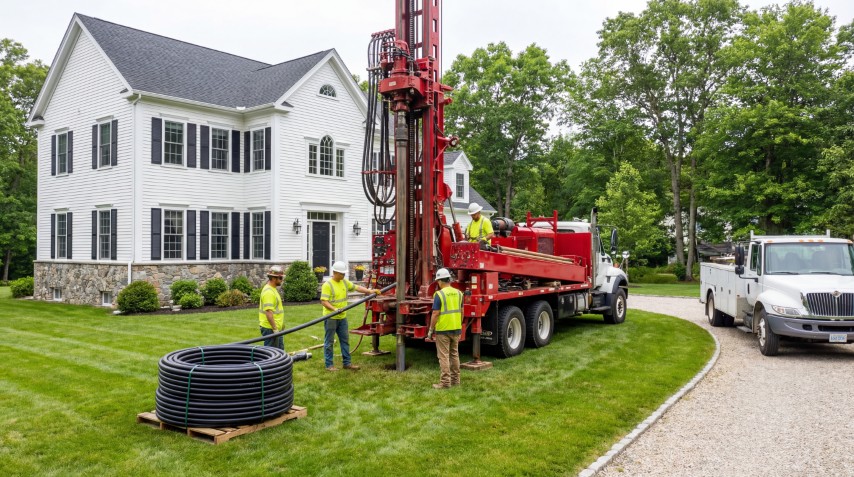
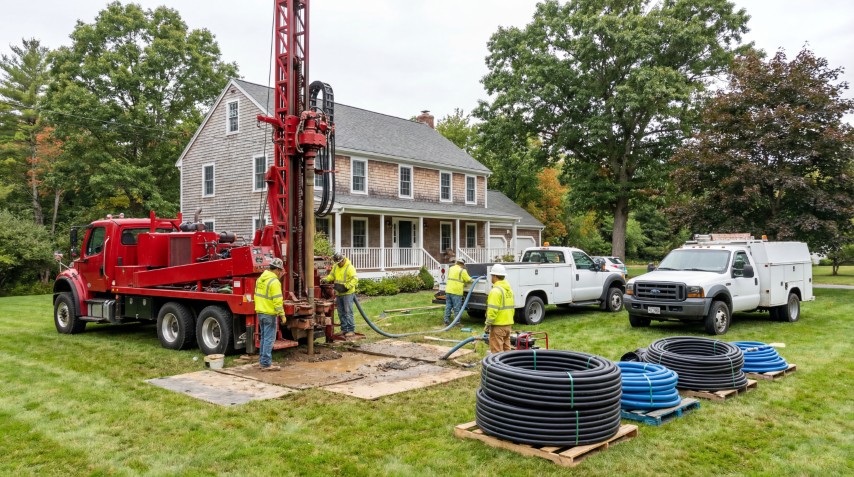
Many homeowners assume geothermal requires tearing up their entire backyard. In reality, modern bedrock rotary drilling rigs have an exceptionally compact footprint. A typical 3,000 sq ft home requires just one or two vertical boreholes, each about 6 inches in diameter, drilled 400 to 500 feet into bedrock.
The boreholes are spaced 15 to 20 feet apart, looped with factory-certified HDPE pipe, pressure-grouted, and buried 5 feet underground. Once the lawn is graded and hydroseeded, there is zero visible equipment, zero fan noise, and zero outdoor AC condensers.
Learn how your home can benefit by exploring our in-depth What is GeoExchange Master Guide, or request a free residential site feasibility review today.