Moving Heat, Not Creating It: The Earth as a Constant Thermal Battery
In virtually every community across New England, property owners and commercial facility directors are drastically reducing their energy overhead with GeoExchange (ground-source geothermal) heating and cooling.
Unlike conventional furnaces or boilers that must burn fossil fuels—natural gas, propane, or heating oil—GeoExchange systems never create heat through chemical combustion. There is no open flame, no fuel storage tank, zero carbon monoxide hazard, and no dependence on volatile heating oil or propane tanker deliveries during winter storms.
Instead, the system relies on an immutable physical reality: just 6 to 10 feet below the surface of the Earth, the ground remains at a stable temperature year-round—between 48°F and 54°F across Massachusetts, New Hampshire, and surrounding New England states. While ambient winter air plunges to -10°F and summer heat soars to 95°F, the deep bedrock beneath your property acts as a massive, self-replenishing thermal battery.
"Approximately 70 percent of the heat energy delivered by a GeoExchange system is clean, renewable solar heat stored permanently in the bedrock. The only supplemental energy required is the modest electrical input used to power the vapor-compression cycle and variable-speed circulator."
- Winter Heat Source: -10°F to 20°F Air (Heat content is severely depleted; COP drops to 1.8–2.2).
- Summer Heat Sink: 90°F+ Humid Air (Compressor works hard to reject building heat).
- Outdoor condenser exposed to snow drifts, freezing rain, and salt air corrosion.
- Defrost cycles consume parasitic electric resistance strip heat.
- Winter Heat Source: Constant 50°F Bedrock (Abundant thermal density; steady COP 4.2–5.2+).
- Summer Heat Sink: Cool 50°F Ground (Effortless heat absorption with near-free cooling).
- 100% of mechanical equipment located indoors; completely silent exterior with zero outdoor unit.
- Immune to weather extremes, blizzard wind chills, and power surge icing.
Two Appliances in One: Whole-Home Heating and Central Air Conditioning
GeoExchange systems do the work that ordinarily requires two separate appliances—a heating furnace or boiler and a central air conditioner. Here is how the closed loop and reversing valve operate across New England seasons:
Winter Heating Cycle
- Loop Absorption: Circulating water/glycol solution absorbs natural 50°F thermal energy from the underground bedrock loop.
- Vapor Compression: Fluid transfers heat to refrigerant in the indoor heat pump; the scroll compressor concentrates the heat to 105°F–120°F.
- Indoor Distribution: Duct air handlers or radiant in-floor manifolds distribute warm, gentle heat to all living spaces.
- Continuous Loop: Cooled fluid returns underground to be rewarmed by the earth in an endless closed loop.
Summer Cooling Cycle
- Heat Extraction: Warm, humid air from your home is drawn across a cold evaporator coil, condensing out humidity for superior comfort.
- Thermal Transfer: Indoor heat is transferred from the refrigerant into the closed ground loop fluid.
- Earth Absorption: Heat is smoothly rejected into the 50°F ground with far higher efficiency than blowing into 95°F outdoor air.
- Free Domestic Hot Water: Excess heat can be redirected via a desuperheater to provide 100% free domestic hot water.
Making Hot Water: The Desuperheater Heat Recovery Advantage
Domestic water heating represents 18% to 25% of annual utility bills in New England. GeoExchange systems dramatically reduce or eliminate this ongoing expense through the addition of an integrated desuperheater.
A desuperheater is a specialized auxiliary heat exchanger integrated inside the geothermal heat pump cabinet. It captures superheated discharge gases (160°F+) leaving the compressor before they reach the main condenser.
During the summer cooling season, that intense waste heat is diverted directly into your domestic hot water storage tank—delivering virtually 100% free hot water whenever air conditioning is running. In winter, the desuperheater preheats incoming 45°F well water up to 110°F–120°F, cutting water heating energy by over 50%.
The 6 Earth Connections: How Subsurface Loops Are Configured
Because New England geology ranges from shallow crystalline granite bedrock to deep glacial till and coastal aquifers, ground loops are custom-engineered for site topography and lot dimensions:
1. Vertical Closed Loops
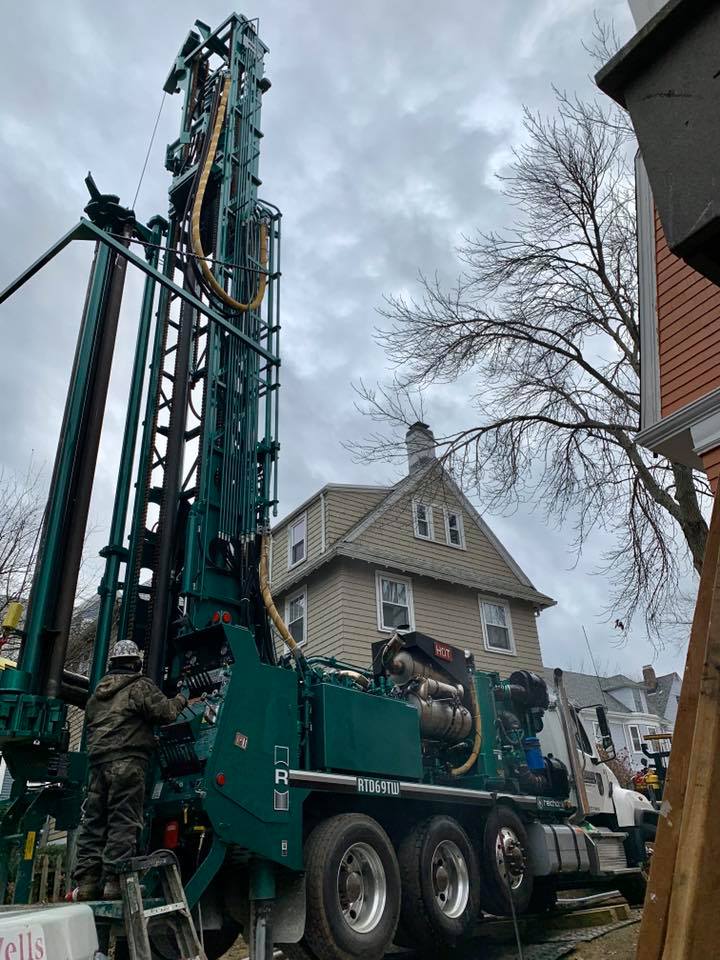
Rotary rigs bore vertical holes 150 to 500 feet deep into bedrock. A continuous high-density polyethylene (HDPE 4710) U-tube is inserted, and the borehole is pressure-grouted from bottom to top with thermally enhanced bentonite/graphite grout.
2. Standing Column Wells (SCW)
A 6-inch diameter bedrock well drilled 1,000 to 1,500 feet deep. Groundwater is drawn from the bottom, circulated through building heat exchangers, and returned to the top of the same well column. A controlled bleed optimizes peak temperature.
3. Horizontal Closed Loops
Trenches 4 to 6 feet deep are excavated across open land. Parallel runs of HDPE pipe or overlapping "slinky" coils are laid and backfilled. Often cost-effective on large rural parcels where bedrock is deep or excavation is simple.
4. Pond & Lake Closed Loops
If the property sits adjacent to an adequate body of water, coiled HDPE loops are weighted and submerged. Water transfers heat faster than soil, resulting in minimal trenching and lower installation cost.
5. Open Loop (Groundwater)
Groundwater is pumped directly from a high-yield potable well through the heat pump’s heat exchanger and returned to the aquifer via a recharge well.
6. Direct Expansion (DX)
Direct Expansion systems circulate refrigerant directly through buried copper tubing rather than an intermediate water/glycol loop.
The 5-Step GeoExchange Installation Process
From initial geological modeling through final mechanical commissioning, GDNE manages every stage of ground loop development in accordance with IGSHPA and MassDEP standards:
Step 1: Thermal Sizing & Geological Conductivity Assessment
We calculate precise heating and cooling peak loads using ACCA Manual J/D standards and model the subterranean formation (granite, schist, or sandstone) using Ground Loop Design (GLD) software. For commercial projects, an in-situ Thermal Response Test (TRT) measures exact bedrock thermal conductivity.
Step 2: Rotary Bedrock Borehole Drilling
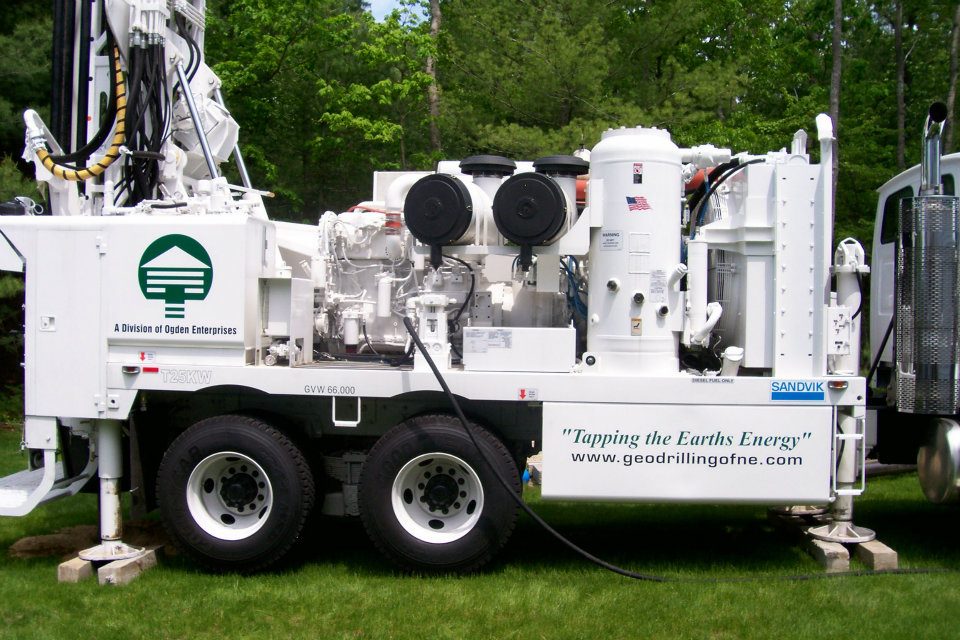
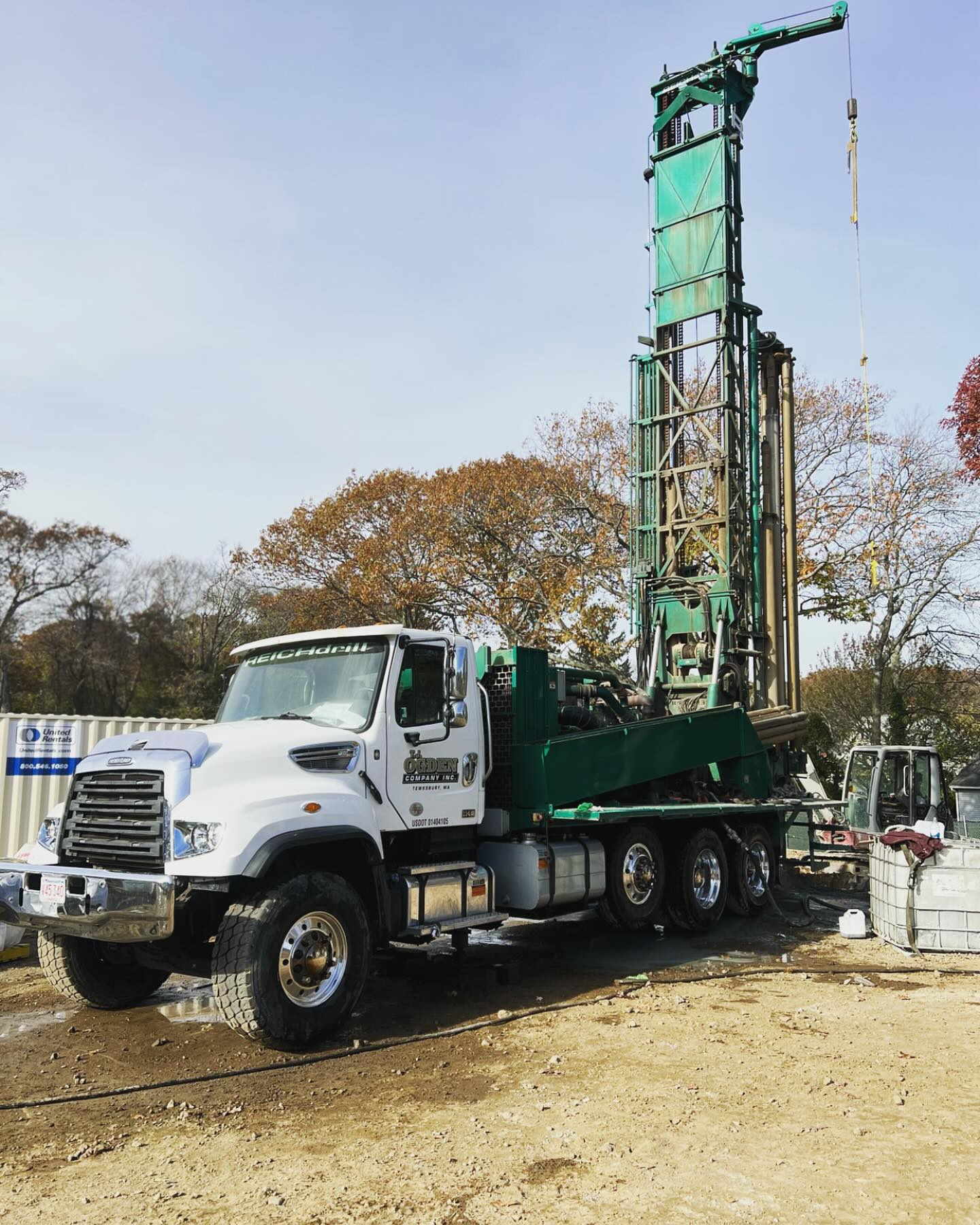
Our licensed drilling crews mobilize heavy rotary air-hammer rigs to bore 6-inch diameter holes into New England bedrock (typically 300 to 500 feet per vertical borehole). Steel casing is seated through unconsolidated overburden and anchored into competent rock to seal surface aquifers.
Step 3: Continuous HDPE U-Tube Insertion & Grouting
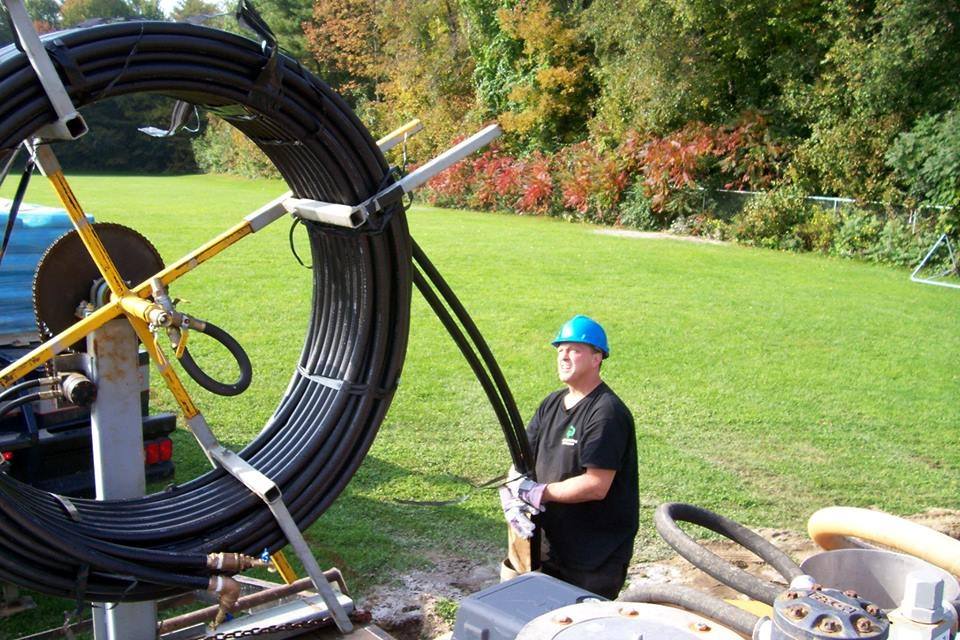
Continuous loops of virgin HDPE 4710 pipe with factory-molded reverse U-bends are inserted to the full depth of each borehole. The borehole is then pressurized and grouted from the very bottom to the surface using thermally enhanced bentonite/graphite grout (0.88–1.2+ BTU/hr-ft-°F) to ensure maximum heat transfer.
Step 4: Header Trenching, Electrofusion & Pressure Testing
Crews excavate horizontal trenches 4 to 6 feet below grade (well below the New England frost line). Individual borehole loops are connected to supply and return headers using thermal socket electrofusion. The entire underground circuit is hydrostatically pressure-tested to 100+ PSI for 4 hours with zero pressure decay.
Step 5: Heat Pump Mechanical Tie-in & Commissioning
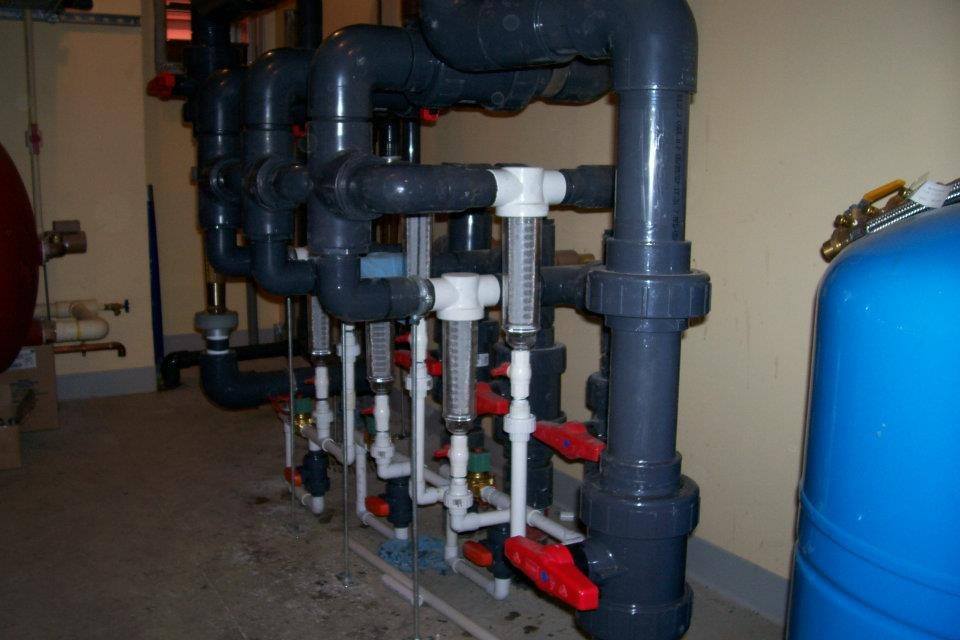
The underground loop enters the mechanical room via core-drilled, water-sealed foundation penetrations. Certified HVAC installers tie the loop into the geothermal heat pump, connect the desuperheater for domestic hot water, charge the system with an environmentally safe propylene glycol solution, and verify flow rates and operating COP.
50-Year HDPE Pipe & Molecular Heat Fusion Joints
Property owners frequently ask: "What happens if the underground pipes leak after installation?"
The answer lies in High-Density Polyethylene (HDPE 4710 / PE100). Engineered specifically for continuous ground heat transfer, modern geothermal pipe is impervious to corrosion, rust, acidic groundwater, biological attack, and chemical breakdown.
When GDNE crews connect vertical U-tubes to horizontal header trenches, they use thermal heat fusion (butt fusion or socket electrofusion). The polymer chains melt and interweave into a single continuous molecular structure.
IGSHPA Standards & Quality Checklist
- ✓ASTM D3035 / D3261 Certified: Virgin PE4710 resin designed for cyclic thermal expansion and high hoop stress.
- ✓Thermally Enhanced Bentonite: High thermal conductivity grout (0.88–1.2+ BTU/hr-ft-°F) completely seals the borehole and isolates aquifers.
- ✓100 PSI Hydrostatic Test: Manifolds tested for 4 hours with zero pressure drop before trench backfill.
- ✓50-Year Manufacturer Warranty: Design life exceeding 100 years underground with zero ongoing maintenance.
Why New England Bedrock is Premier for GeoExchange
New England is underlain by some of the densest crystalline igneous and metamorphic bedrock formations in North America. These dense crystalline rocks exhibit exceptionally high thermal conductivity (1.8 to 2.4+ BTU/hr-ft-°F), transferring heat into and out of ground loops far faster than the sedimentary sands and soft clays of the Mid-Atlantic or Southeast. This geological advantage allows New England borefields to achieve higher heating and cooling capacities with fewer linear feet of borehole drilling.
| State & Region | Primary Geological Formations | Mean Ground Temp (°F) | Thermal Conductivity (BTU/hr-ft-°F) | Typical Sizing (Ft/Ton) | 2026 Clean Heat Incentive |
|---|---|---|---|---|---|
| Massachusetts (Eastern) | Dedham Granodiorite, Cambridge Argillite, Boston Basin | 50°F – 52°F | 1.80 – 2.25 | 140 – 170 ft/ton | Mass Save up to $25k + 0% HEAT Loan |
| Massachusetts (Central & Western) | Worcester Schist, Stockbridge Marble, Berkshire Gneiss | 49°F – 51°F | 1.65 – 2.10 | 150 – 180 ft/ton | Mass Save + Municipal Light rebates |
| New Hampshire | Conway Granite, Winnipesaukee Tonalite, Metamorphic | 47°F – 50°F | 1.90 – 2.45 | 140 – 165 ft/ton | NHSaves utility clean heat rebates |
| Connecticut | Hartford Basin Sandstone, Basalt Traprock, Crystalline Gneiss | 51°F – 54°F | 1.50 – 1.95 | 160 – 190 ft/ton | Energize CT up to $15,000 |
| Rhode Island | Narragansett Basin Shale & Meta-anthracite, Westerly Granite | 50°F – 53°F | 1.70 – 2.15 | 150 – 175 ft/ton | Clean Heat RI up to $12,000 |
| Maine | Norumbega Granites, Penobscot Pelitic Schists | 45°F – 48°F | 1.85 – 2.30 | 150 – 180 ft/ton | Efficiency Maine clean heating grants |
| Vermont | Green Mountain Metamorphics, Champlain Valley Carbonates | 46°F – 49°F | 1.75 – 2.20 | 150 – 180 ft/ton | Efficiency Vermont heat pump incentives |
| Eastern New York | Taconic Slates, Hudson Highlands Metamorphic Belt | 50°F – 53°F | 1.65 – 2.10 | 155 – 185 ft/ton | NYSERDA Clean Heat incentives |
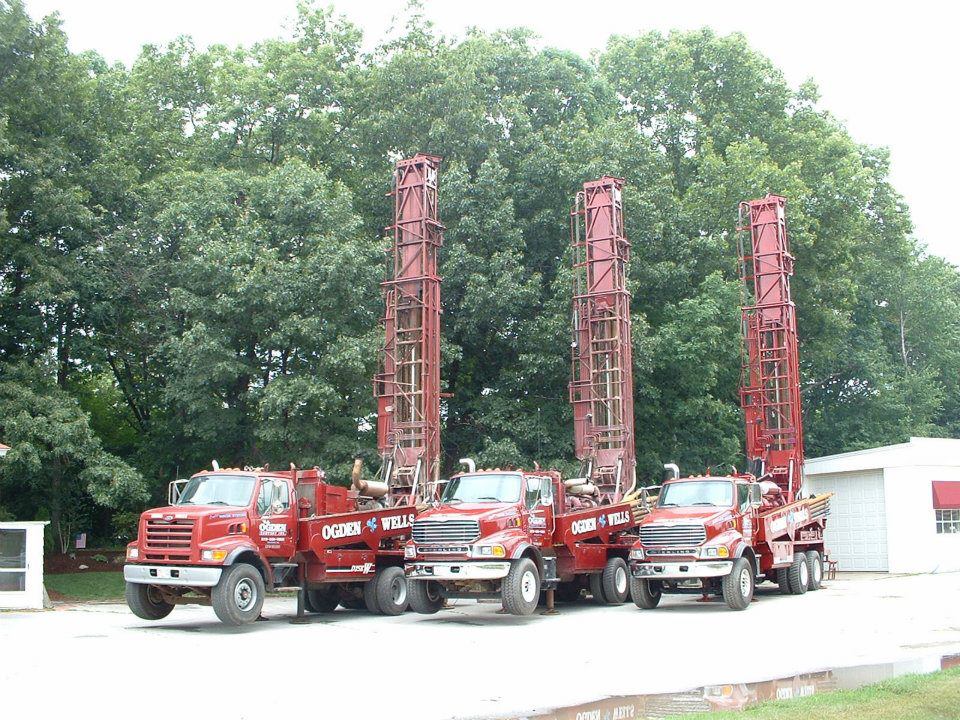
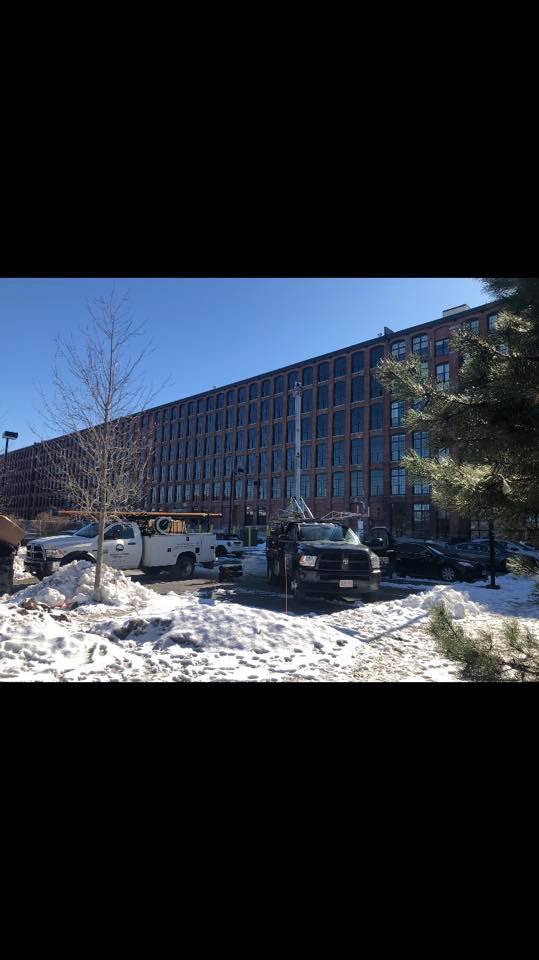
Regional Fleet Stationed in Tewksbury, MA
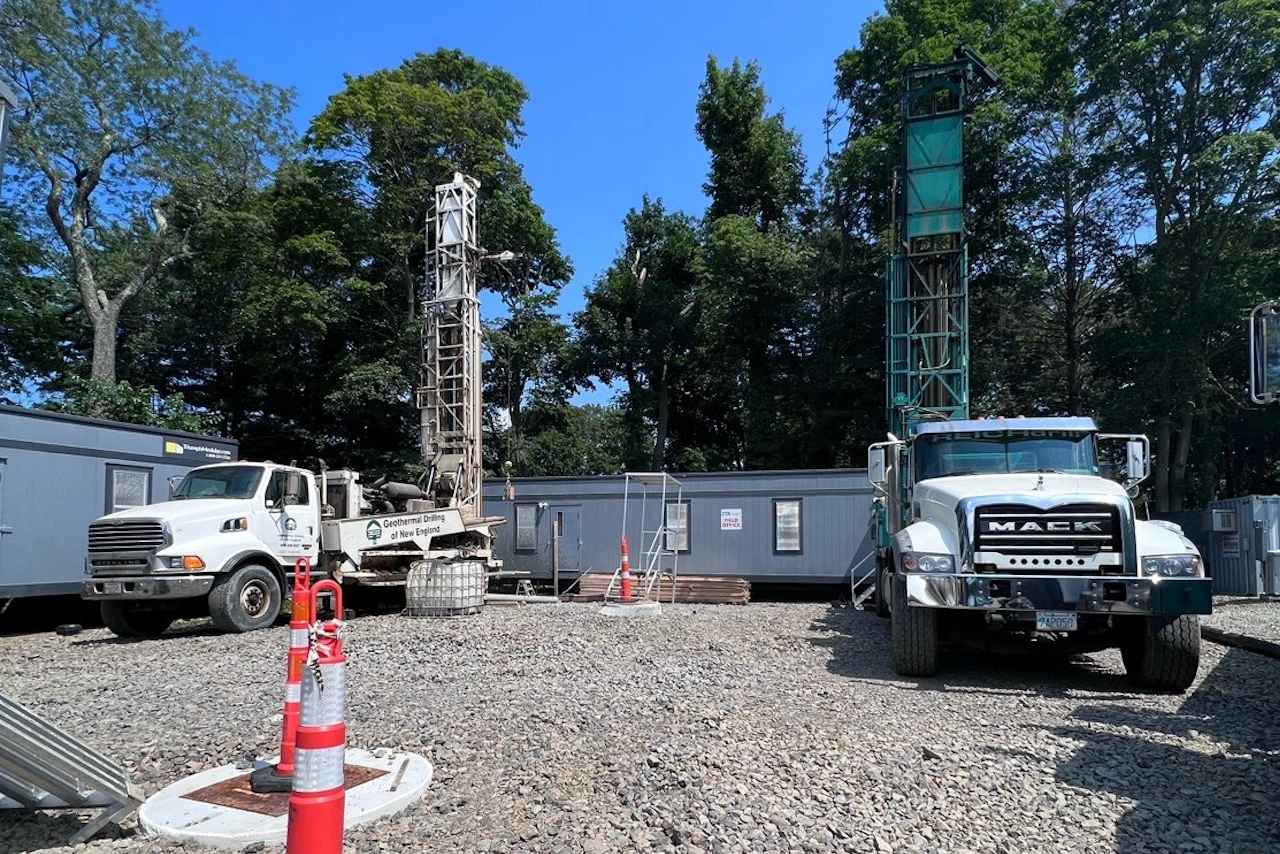
With master drilling licenses across Massachusetts, New Hampshire, and neighboring New England jurisdictions, GDNE and Ogden Wells deploy dedicated rotary rigs, support service trucks, and certified electrofusion equipment directly to municipal, commercial, and residential projects throughout the region.
Compare GeoExchange vs. Conventional Fuels
Calculate your estimated seasonal heating bill difference based on verified 2026 New England fuel and electricity benchmarks.
Environmental Protection Agency (EPA) Efficiency Benchmarks
In a landmark study by the U.S. Environmental Protection Agency (EPA), Space Conditioning: The Next Frontier (Office of Air and Radiation, 430-R-93-004), federal researchers analyzed all primary heating and cooling technologies across their full fuel cycles—including powerplant generation and grid transmission losses. The EPA confirmed that GeoExchange systems are the most energy-efficient, environmentally clean, and cost-effective space conditioning systems available.
Even condensing gas furnaces lose energy compared to ground heat extraction.
Permanent elimination of on-site fuel combustion, oil tanks, and delivery risk.
Over 95% of GeoExchange owners would recommend the system to family or friends.
Indoor mechanical placement protects equipment from New England snow, ice, and salt.
GeoExchange Terminology & Physics Definitions
Standardized engineering definitions codified under IGSHPA, ASHRAE, and MassDEP regulatory frameworks:
- Coefficient of Performance (COP)
- The ratio of thermal energy output to electrical energy input. A COP of 4.5 indicates that for every 1 unit of electricity consumed, 4.5 units of heat are delivered into the building (450% thermodynamic efficiency).
- Energy Efficiency Ratio (EER)
- Cooling efficiency metric calculated as BTUs of cooling divided by electrical watts consumed. GeoExchange systems regularly achieve EER ratings of 22 to 32+, compared to conventional central air conditioning at 13 to 16.
- Thermal Response Test (TRT)
- An empirical in-situ engineering test performed on a pilot borehole. A constant thermal load is applied for 48 hours to measure undisturbed ground temperature, effective formation thermal conductivity ($k$), and borehole thermal resistance ($R_b$).
- Standing Column Well (SCW)
- A semi-open deep bedrock well (1,000–1,500 ft) where water is recirculated within the same borehole. Controlled bleed (typically 5%–10%) during peak heating or cooling induces fresh groundwater flow into the column to stabilize temperatures.
- Desuperheater
- An auxiliary brazed plate heat exchanger that extracts sensible heat from superheated compressor discharge refrigerant vapor to heat domestic potable water before entering the main heat exchanger.
- Thermally Enhanced Bentonite Grout
- A specialized mixture of sodium bentonite clay, silica sand, and graphite additives formulated to achieve thermal conductivity values between 0.88 and 1.2+ BTU/hr-ft-°F while ensuring an impermeable hydraulic barrier between aquifers.
Mass Save® Rebates Up to $25,000 + 0% HEAT Loan
Massachusetts and neighboring New England states provide the nation’s most aggressive clean heating incentives. Homeowners can capture up to $25,000 in direct cash rebates plus 0% interest financing for 7 years:
- ✓ Mass Save Whole-Home Rebate: $13,500 standard / $25,000 income-eligible.
- ✓ 0% Interest HEAT Loan: Up to $25,000 with 7-year repayment terms.
- ✓ Alternative Energy Credits (AECs): Ongoing quarterly cash revenue under MA APS.
- ✓ Commercial Section 48 ITC: 30% to 50% federal tax credits for commercial and institutional borefields.
Common Questions About GeoExchange Systems
Is GeoExchange practical for existing home retrofits or only new construction?
GeoExchange is routinely retrofitted into existing homes across New England. Compact rotary drilling rigs access backyards via driveways or side lawns with minimal disruption. The new ground loop connects directly to your existing ductwork or hydronic heating distribution inside your mechanical room.
Will a GeoExchange heat pump keep my home warm during -10°F New England blizzards?
Yes, absolutely. Unlike air-source heat pumps that lose heating capacity as outside air freezes, GeoExchange draws heat from 50°F bedrock hundreds of feet deep. The subsurface ground temperature never drops below freezing, so your system delivers full rated heating capacity regardless of how cold the outdoor air becomes.
Why is New England bedrock considered ideal for GeoExchange?
New England crystalline igneous and metamorphic rock (such as Dedham granodiorite, Conway granite, and Worcester schist) provides high thermal conductivity (1.8 to 2.4+ BTU/hr-ft-°F). This conducts heat into and out of loop piping much faster than soft clays or sands, reducing required total borehole footage.
What ongoing maintenance does a GeoExchange system require?
Maintenance is minimal—comparable to a refrigerator. Because all equipment is indoors (safe from ice, storms, and coastal salt) and the underground HDPE loop is sealed with no moving parts, maintenance primarily involves periodic air filter changes and an occasional loop pressure inspection.
How does a GeoExchange system affect home resale value?
Appraisal studies consistently indicate that homes with geothermal heating and cooling command a tangible market premium. Prospective buyers value the complete elimination of oil tanks, zero risk of fuel delivery disruptions, whisper-quiet operation, and dramatically lower monthly utility expenses.
What is the difference between closed loop vertical boreholes and standing column wells?
Closed loop systems circulate a sealed water/glycol mixture through continuous HDPE U-tubes backfilled with thermal grout. Standing column wells draw groundwater directly from the bottom of a 1,000–1,500 ft bedrock well and return it to the top. SCWs are ideal for tight urban lots in Boston and Cambridge where multiple closed boreholes cannot fit.
What happens if the underground pipes leak and how long does HDPE pipe last?
GeoExchange systems utilize High-Density Polyethylene (HDPE 4710) pipe. All connections are heat-fused (molecularly bonded), making joints stronger than the pipe itself with zero mechanical couplings underground. The pipe is completely immune to rust and groundwater corrosion, carrying 50-year warranties and a 100+ year design life.
What is the relationship between GDNE and Ogden Wells?
Geothermal Drilling of New England (GDNE) is the specialized geothermal borefield division of T.J. Ogden Co., Inc. (Ogden Wells). Founded in 1980 by Tom Ogden (Master Well Driller #1042) and operated with Samantha Ogden, Ogden Wells provides over 45 years of groundwater drilling legacy, master crews, and heavy rotary equipment to deliver turnkey geothermal borefields across Massachusetts, New Hampshire, and New England.
Need Drinking Water Well Drilling, Pump Service, or Filtration?
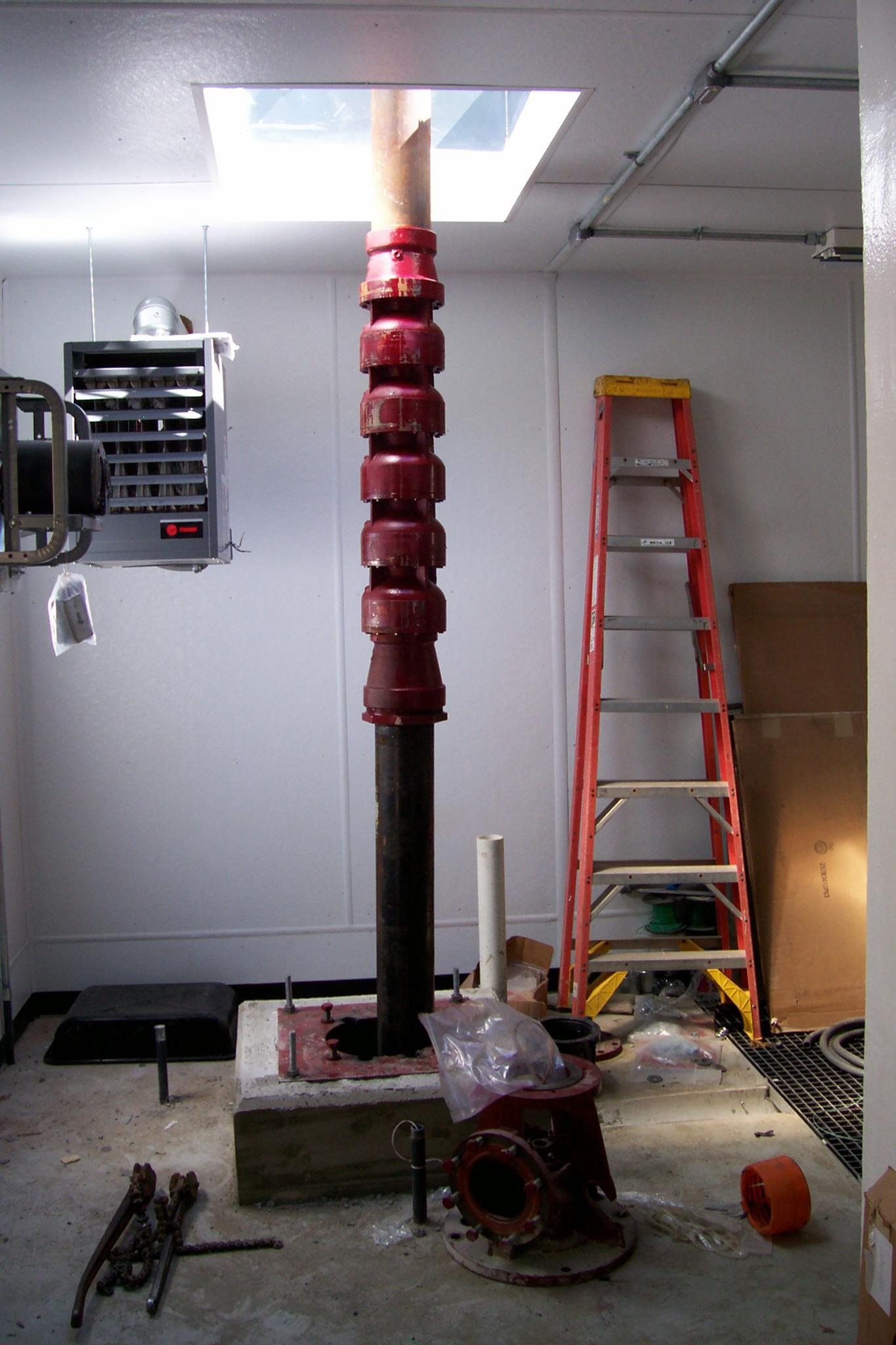
GDNE is backed by T.J. Ogden Co., Inc. (Ogden Wells)—New England’s trusted water well and municipal pump professionals since 1980. From high-capacity municipal water pumps to residential wells, filtration, and 24/7 emergency service, our sister division handles all potable water needs.
Ready to Explore GeoExchange for Your Property?
Speak directly with our geothermal drilling engineers. We will analyze your property dimensions, New England bedrock geology, and estimated heating/cooling loads.